High quality products
Guaranteed delivery
Shipment in 2 business days
Safe shopping
Payment options: Credit Card, PayPal, WERO or Bank transfer

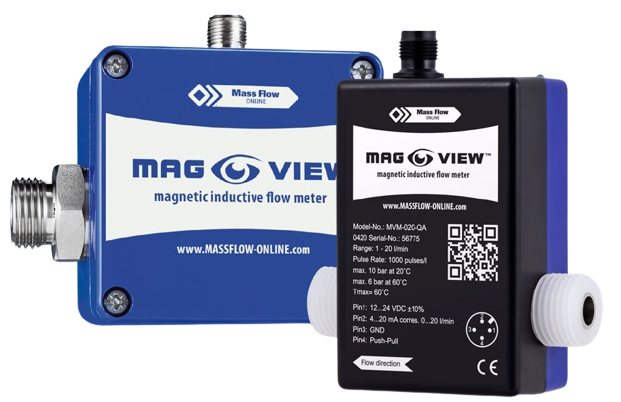
Electromagnetic flow meter for measuring and dosing conductive liquids

An electromagnetic flow meter (also called a magnetic or mag flow meter) measures the flow of electrically conductive liquids using Faraday's law: liquid moving through a magnetic field generates a voltage that is proportional to its flow velocity. The MAG-VIEW™ series works on this magnetic inductive principle. Because it has no moving parts, operates free of interference and is insensitive to contaminated liquids, it is a reliable choice even in compact machines with cramped confines.

MAG-VIEW electromagnetic flow meters

Advantages of MAG-VIEW™

  • No moving parts, so no mechanical wear and a long life cycle
  • Interference free operation
  • Works where paddle wheel or turbine sensors cannot be applied
  • Insensitive to pressure peaks, particles and contaminated liquids thanks to protected transducers
  • Short inlet and outlet sections, ideal for compact machines
  • Free pipe cross section: no additional pressure drop

Which MAG-VIEW™ do I need?

  • Plastic version (QA): cost-optimized and lightweight, for water and water-like liquids.
  • Metal version (PA / PN): robust metal housing for higher temperatures and pressures.
  • Hastelloy C® version (QAH): for aggressive and corrosive liquids such as acids and salt water. The Hastelloy® electrodes keep measurement and dosing precise where standard electrodes would corrode. Popular in chemical dosing, water treatment and agriculture.

Where is the MAG-VIEW used? What are the features of the MAG-VIEW?

See the table below for all models with their flow ranges, materials and outputs.
↓ See table ↓

Find your ideal flow meter in 30 seconds
  • 30 seconds
  • No quote needed
  • Straight to the product

Flow Ranges


Metal version
 (Robust metal housing for high temperatures and pressures)

Analog (4-20 mA) Output + 

Frequency output

Metal version
 (Robust metal housing for high temperatures and pressures)

Frequency Output

Plastic version
(Cost-optimized and lightweight plastic design)

Analog (4-20 mA) Output + Frequency output


Plastic version
(Cost-optimized and lightweight plastic design)

Analog (4-20 mA) Output + Frequency output

Hastelloy C®

0.0083 .. 1 l/minMVM-001-PAMVM-001-PN

0.05 .. 2 l/min
MVM-002-PAMVM-002-PN

0.1 .. 2 l/min

MVM-002-QA
MVM-002-QAH
0.25 .. 5 l/min

MVM-005-QAMVM-005-QAH
1 .. 20 l/min


MVM-020-QAMVM-020-QAH
0.1 .. 30 l/min
MVM-030-PA
MVM-030-PN

2.5 .. 50 l/min


MVM-050-QAMVM-050-QAH
0.2 .. 60 l/minMVM-060-PAMVM-060-PN

5 .. 200 l/min


MVM-200-QAMVM-200-QAH
12.5 .. 250 l/min


MVM-250-QA
5 .. 250 l/minMVM-250-PAMVM-250-PN

Features

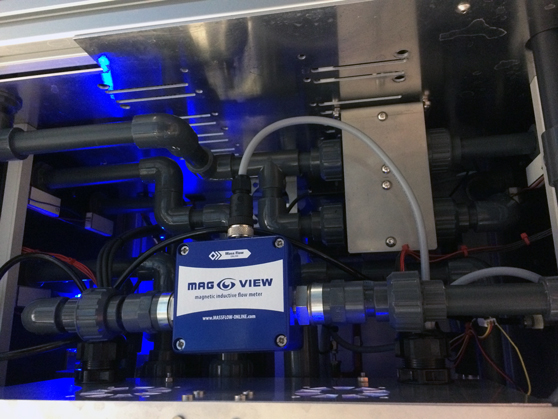
  • Magnetic Inductive Flow meter MAG-VIEW built in a machineMake liquid flows visible by pulse frequency output, analog output (4 .. 20 mA) or blinking LED (red/green)
  • Repeatability ≤1% of reading, Reassures process reliability
  • No moving parts (no mechanical wear)
  • Ease of mounting and operation, works independent from position
  • Free pipe cross section, no additional pressure drop
  • Fast response
  • Insensitive to changes of viscosity, consistent accuracy
  • Insensitive with contaminated liquids
  • Ideal solution for interference free operation combined with a long-life cycle
  • Wide independence to the inlet and outlet pipes create the advantage to be able to install in compact machines with cramped confines.
  • Lightweight and compact design
  • Suitable for mobile applications
  • Low power consumption


Applications

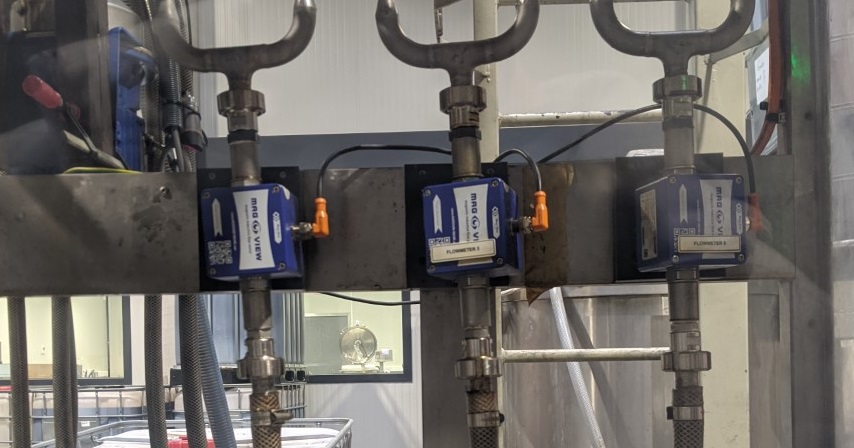
MAG-VIEW Application 4-20ma

The fields of application for this mag meter meter are diverse:
They can be used in areas where flow sensors with moving parts (paddle wheel, turbine sensors) cannot be applied due to contaminated media. The sensor is intended for continuously measuring of flow rates or for dosing / batching of electrically conductive liquids with a minimum of 20 or 50 µS/cm is makes liquid flows visible.

  • General Engineering: Measuring of cooling water, measuring of waste water, dosing of mold release agents 
  • Cleaning Industry: Dosing of detergents and other additives
  • Concrete Production: Dosing of agents and colours
  • Agriculture and Livestock: Dosing of water, fertilizer, fungicides and pesticides, measuring of water and liquid feed supplements
  • Exhaust Gas Cleaning: Dosing of AdBlue